
How Funding Alignment Ends Homelessness
I’ve gradually stumbled into a very unexpected niche - helping communities determine how much money they are currently spending on their homeless system of care, as well as answering the even more important question of how much they should be spending.
The first time this happened was about nine years ago.
At that time, I helped co-found and co-lead a collective impact group for a CoC in the San Francisco Bay Area. “Opening Doors Marin” was an effort to bring together elected leaders, executive government staff, service providers, philanthropy, and business to help advance our efforts to end chronic homelessness.
As is the case in many communities, we assumed our major limiting factor to more progress was funding. We just needed more.
So we did what we saw peers doing:
- We raised money to hire a political consultant and pollster.
- They told us how much money we might raise from a bond measure.
- With that number, we came up with a spending plan.
(After years of effort, we begrudgingly admitted that the political support wasn’t there, even in one of the most “liberal” communities in the country.)
The second time I did this, the process was totally different.
Instead of being a leader in the community, I came in as a consultant.
That community was already in the middle of a strategic planning process with another consulting firm, and the County asked if I could help them figure out the cost of implementing their new plan.
I didn't fully appreciate it at the time, but this was a completely different frame from before. It was a much deeper question, which at that point, 12 years into this work, I was shocked I had never asked myself - what is the cost of a sufficiently resourced response?
It's No One's Fault, But It's Still Our Responsibility
At a micro-level, I am completely convinced that we are one of the scrappiest and most adaptable sectors in the entire country, doing everything we can to cobble together limited resources to help even one more person.
This spirit and culture, however, cannot bridge our sector’s fundamental problem - decentralization and fragmentation.
Nowhere are the consequences of this fragmentation more evident than in the broken ways in which we fund our systems of care. I have witnessed the following in almost every community where I have worked:
- Boom-and-bust funding cycles, driving reactive instead of strategic planning
- A scarcity mindset, fostering provider competition over collaboration
- Duplication of effort, investing in similar but uncoordinated activities
- Low wages, increasing staff turnover and reducing program effectiveness
- Inconsistent metrics and outcomes, making impact and results hard to assess
- Stakeholder confusion, blurring accountability for who funds and delivers services
- Funding process inertia, keeping procurement efforts stuck in the same place
Let me give a very concrete example of how this manifests and how it hurts us.
One of the talking points du jour, which I believe is helping to drive the financial "austerity" our sector is currently facing, is that California spent $24B between FY18-19 and FY22-23, and homelessness went up (i.e., our sector "wasted" the money).
We all know how this is usually analyzed. Critics take that total number and divide by the PIT to get what is often an outrageous figure. For example, $24B divided by California's PIT suggests per capita spending of $160,000 per person.
If that was true, I would be up in arms too, but this is flagrantly inaccurate.
In January of 2019, roughly 150,000 people were experiencing homelessness in California. We know, however, that this is just one moment - what about all of the people who enter homelessness for the first time later in the year?
In San Diego, for example, approximately 140% of the people counted during the PIT enter homelessness for the first time later in the year, so using that as a proxy, at least 1,050,000 additional people experienced homelessness over these five years in California.
Just using the correct denominator, the real per capita budget is about $23,000 - 86% less than alleged.
But wait, there's more:
- As much as 50% ($12B) of this funding likely went to capital funding for new housing development — Low Income Tax Credits, Project Homekey, No Place Like Home. That helps housing affordability broadly, but it does not help annual homeless service operating budgets.
- About 27% of California's homeless population is sheltered at any given moment (roughly 40,000 people). The average per unit annual operating cost of shelter in California seems to be about $30K, so if this money covered all of that shelter, that would have been $1.2B per year, or $6B over five years. This spending has nothing to do with housing folks and ending homelessness - it's just keeping people off the street. And that's before capital costs to build new shelter capacity.
- From financial assessments I've done throughout the state, roughly half of annual "homeless service" operating budgets go to supporting people who have already been housed, primarily through permanent supportive housing (PSH). This is critical! The top critique of Housing First is that it's "housing only." Ongoing subsidies AND supportive services are non-negotiable, or people return to homelessness.
If half of what remained after capital and shelter went to PSH operating costs ($3B), the final math looks like this:
($24B - $12B - $6B - $3B) ÷ 1,050,000 = $2,900 per person for everything else - outreach, rapid rehousing, move-in costs, landlord engagement, case management. That's 98% less than alleged and is clearly not even close to what is needed to mount an effective response.
It's tempting to get angry at the people behind these narratives, but what would radical ownership look like? After 45 years of working to end this crisis, are we seriously getting upset with a state auditor doing their best to track all of this funding? Shouldn't we be able to easily and clearly describe where all the money goes?
A Very Different Strategy
Two years ago, thanks to Community Solutions, I had the chance to join a discussion with Houston's former Mayor Annise Parker. Examples like Houston sustain my belief that homelessness is solvable (a 33% unsheltered drop since 2020, a 61% overall drop since 2011).
I know people tend to dismiss Houston's success, attributing it largely to friendly zoning laws, but I think this is just a symptom of our overall fragmentation and tendency to believe “things are different here.”
Instead, I truly believe the key to their success is what Mayor Parker offered: Houston stopped trying to "solve" homelessness and instead got excellent at managing it.
She analogized this strategy to the City’s Public Works Department.
Every city has a certain level of annual infrastructure needs (e.g., roads, bridges, sewers). As a result, every city has a dedicated division that is sufficiently resourced with staff, equipment, and funding to meet these ongoing needs. If this department is consistently under-resourced and/or mismanaged, the city literally crumbles.
From this point of view, our nation's “housing emergency room” is truly unlike every other sustained government operation, from public safety to education to healthcare, each of which has:
- A generally consistent organizational structure across communities (e.g., police precincts, school systems, hospitals)
- A predictable level of resources to meet an ongoing need (which is based on the logic of the organizational structure - that's key)
Homelessness is not like this.
We have hyper-localized our response, which has resulted in wildly different system designs, even across neighboring communities. Making matters worse, we endlessly rebrand and use inconsistent terminology for what are essentially a handful of basic building blocks common to all systems of care (e.g., shelter, outreach), preventing "standardization" and apples-to-apples comparisons.
Very Different Results
To recap the last few newsletters:
- We started this series by exploring a tool I have been using (and you are very welcome to borrow) to help create a jargon free way to visualize the core building blocks of a homeless system of care.
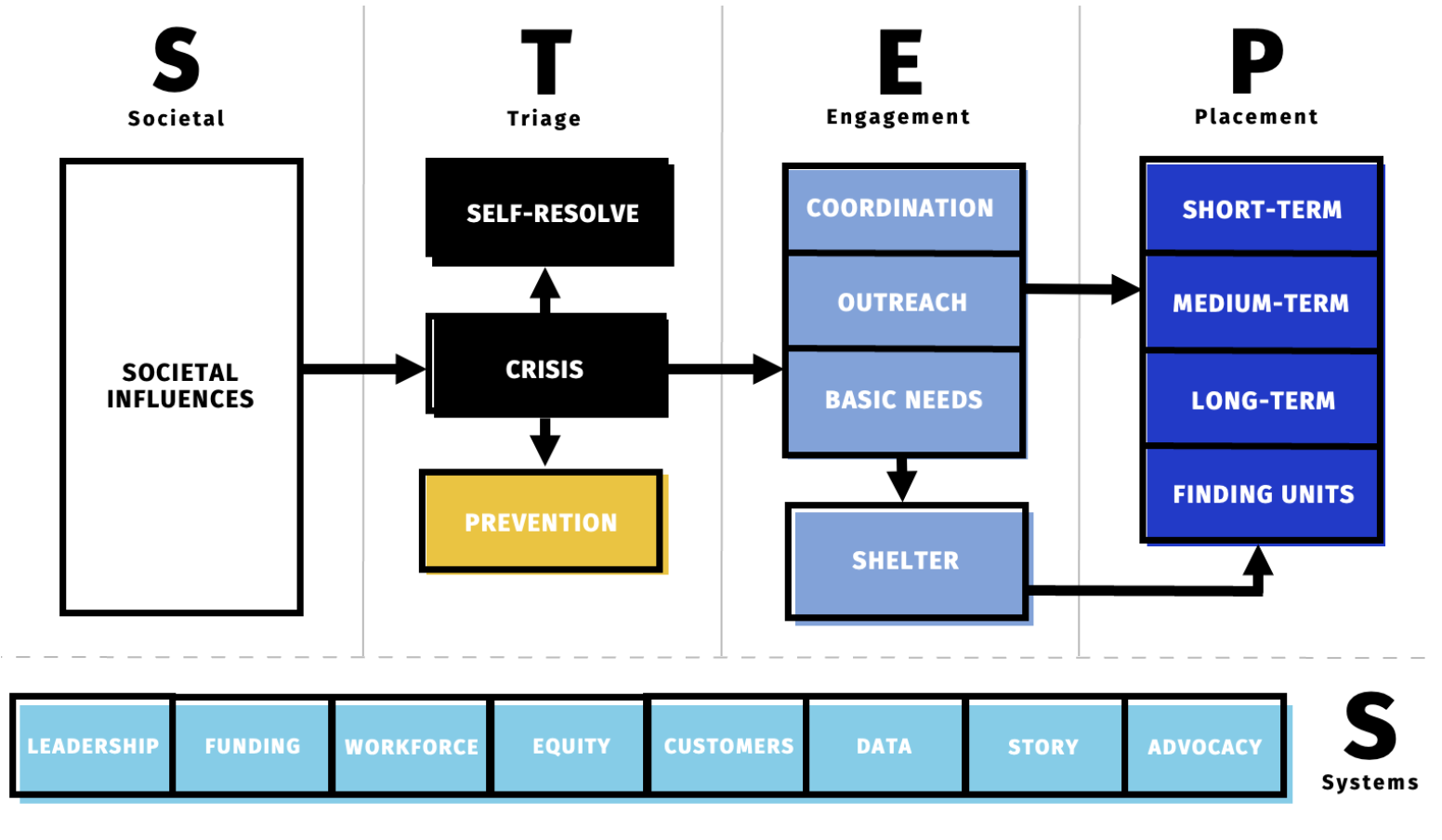
- Once you have this framework in mind, you don’t need an expensive and usually unwieldy strategic plan. Instead, you just need a series of workstreams around each of these unwavering parts / priorities in the system (e.g., preventions efforts that slow inflow, housing placement efforts that accelerate outflow). Within these workstreams, you can then establish annual and quarterly project management cycles to help group similar initiatives, rigorously evaluate from shared metrics, and drive action.
- To make this even easier, last time we talked about viewing each of these parts of the system as a spectrum. To dramatically improve performance, you don’t need to reinvent the wheel - you simply need to identify a peer community who is performing better than you are and just copy what they’re doing.
Best Practices for Effective "Engagement"
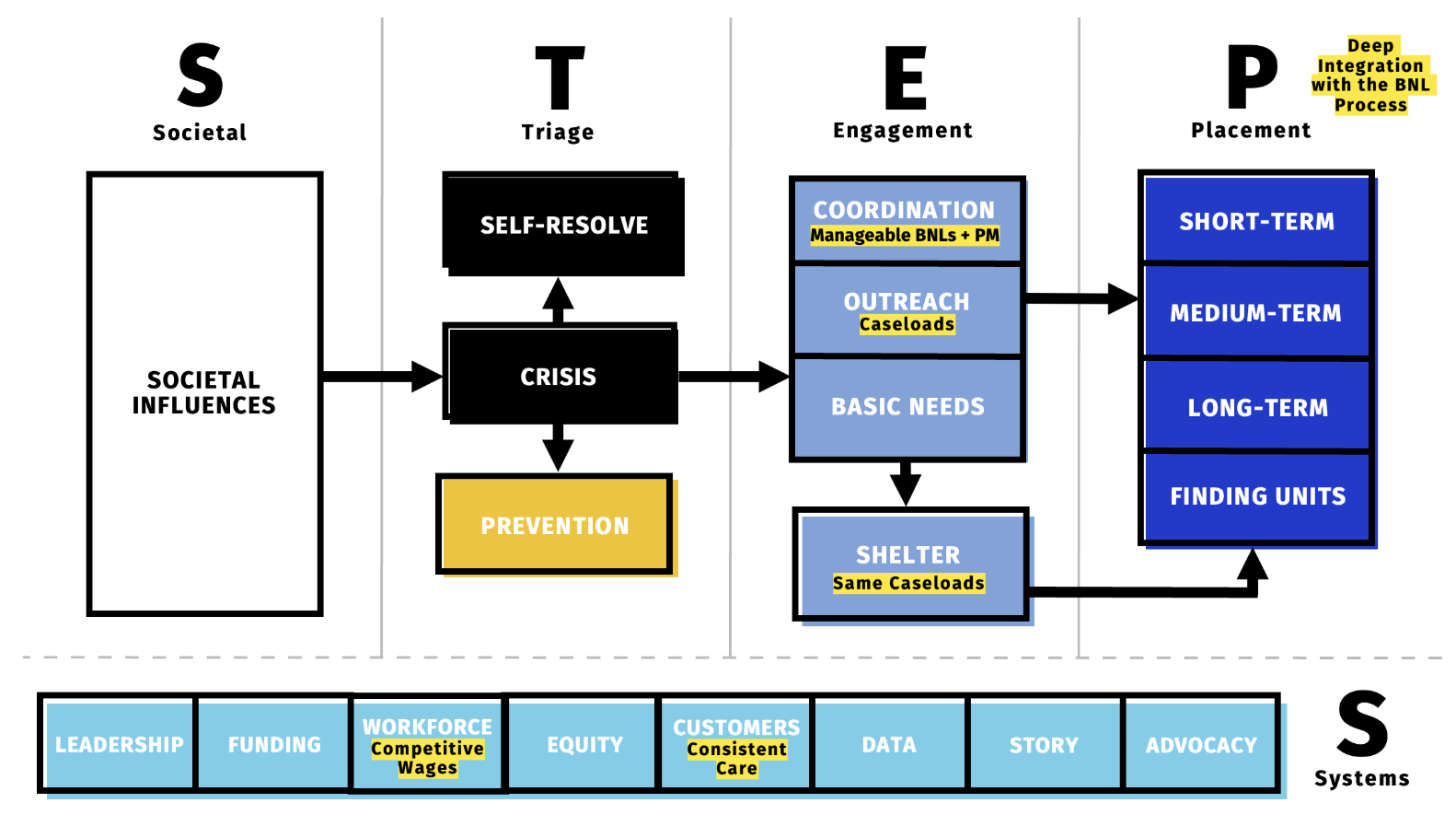
These Best Practices Mapped to a Spectrum
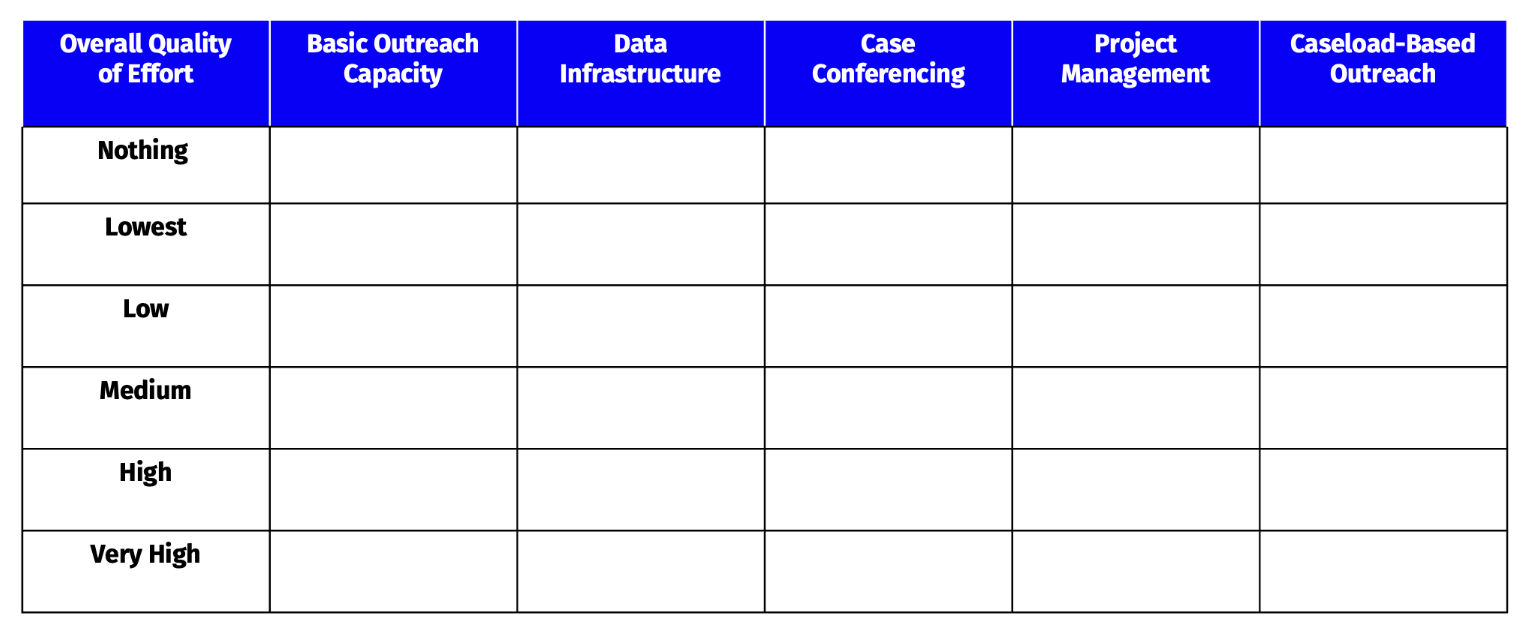
How Communities Usually Progress through This Spectrum
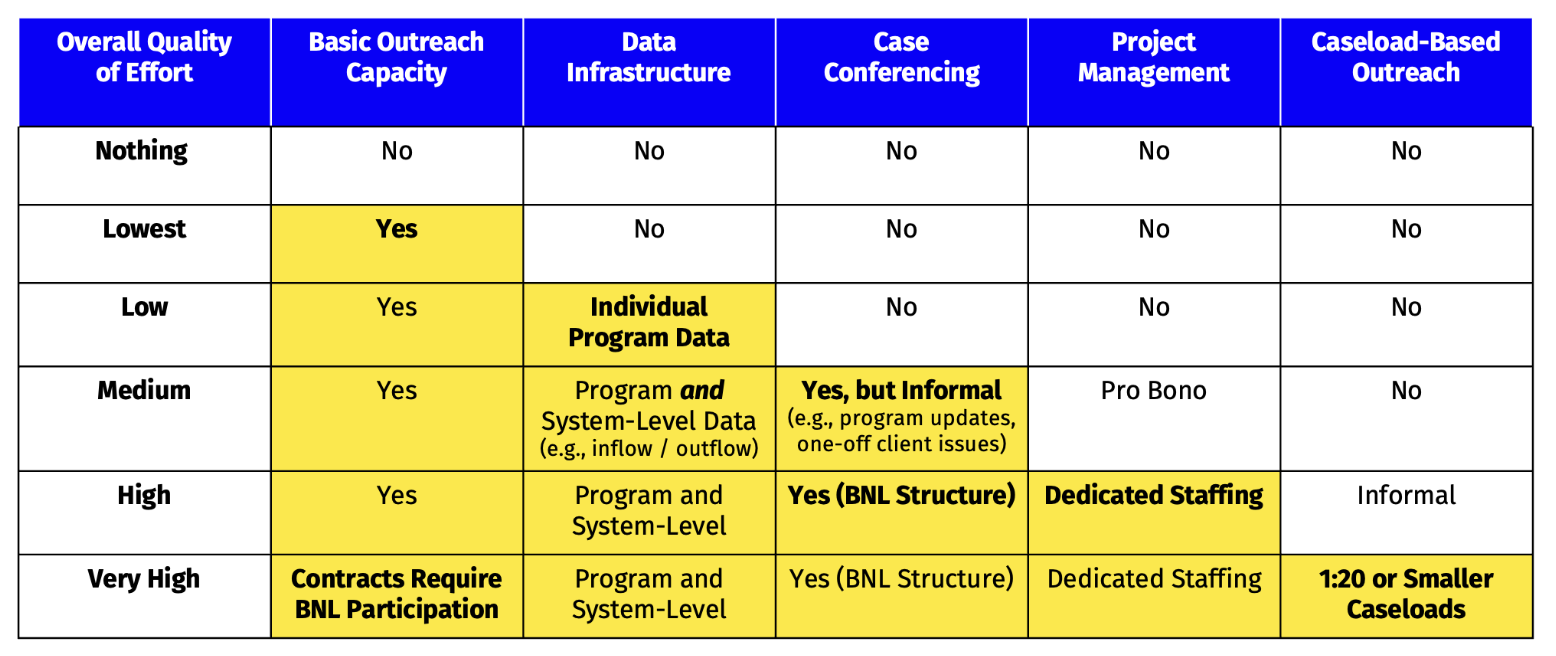
The glue that binds this all together is money.
The earliest version of this “outreach spectrum” emerged out of that second funding projection project that I mentioned at the beginning, which was in Sonoma County, CA.
Most people don’t associate Sonoma County, CA with homelessness, but at one point it had the 3rd highest per capita rate of homelessness in the country, and its PIT has usually hovered around 3,000, making it one of the biggest CoCs in the country.
So here’s what happened. We put numbers to these best practices, asking:
- What if every single unsheltered person was on a reasonably-sized By-Name-List with a dedicated Project Manager overseeing that list?
- What if there was then caseload-based outreach that was managed and coordinated directly through the By-Name-List?
- Finally, what if we assumed living wages and competitive compensation to help reduce staff turnover, since turnover reduces program performance?
When we finally added up the cost of the project managers, the outreach workers, and the right wages for all of them, to be honest, people freaked. It seemed prohibitively expensive.
But here’s the thing. For the first time ever, using STEPS, we had successfully inventoried all of the current spending on homelessness and knew exactly how much we were spending on outreach. It was almost identical to what these projections found!
How, you might be thinking? It was exactly the issues flagged at the beginning:
- Multiple funders investing in uncoordinated, duplicative outreach
- An extremely expensive multi-disciplinary team that was primarily used to clear encampments (i.e., the exact opposite of building consistent care relationships)
This realization - we are already spending the cost of the ideal system on a suboptimal status quo - was enough to catalyze change.
They did move to the subregional BNL system, and the impact has been amazing:
- Active enrollment in HMIS ... 50% to close to 100%
- Coordinated Entry referrals resulting in permanent housing … 30% to 60%
- Outreach exits are to permanent housing … 70%+
- Within a few years, all of this helped drive a 33% overall reduction in homelessness to the lowest PIT numbers they have ever recorded.
I still have a Google alert for “Homelessness Sonoma County,” and last month I saw one of the best headlines one could wish for during these challenging times - “Progress Sustained.”
Experiences like this have given me an unshakable conviction that even during the most challenging times, if we focus on ourselves and what we control and can change, we can in fact make major strides reducing homelessness.