
How to Drive Real Innovation
If you’ve been in this work long enough, I’m willing to bet that at some point a frustrated community member has alleged that you are part of the so-called “Homeless Industrial Complex,” and rather than ending homelessness, you’re actually trying to perpetuate it.
To be very clear, in all of the time I have been working to end homelessness, collaborating with hundreds if not thousands of colleagues, I have not once met a person who is “pro-homelessness.”
- There is no grand, corrupt conspiracy to perpetuate homelessness for the enrichment of those working in this space.
- Every person I have met in this field is genuine in their desire to help people and make a difference.
- If anything, social workers and care providers should be more highly compensated, given the stress, demands, and importance of this work.
While the insinuation of bad motives certainly stings (I’m saying this from personal experience), in all fairness, the homeless service sector as an “industry” is not above reproach.
No one wants homelessness, but over time, because our society has failed to take the necessary steps to prevent it from happening in the first place, a large and robust response system has emerged to try to help people regain housing.
Unfortunately, as anyone who has worked in this field knows all too well, a lot of times we do end up with large and complex systems that are hard for providers to navigate, let alone the people who depend on them for assistance.
This is no one person’s fault per se. Instead, as I wrote last week, it just seems to be the default structure of our response - decentralized and fragmented.
But here’s the thing, even if it’s no one’s fault, that doesn’t mean it’s not our responsibility to fix. And one of the chief drivers of this fragmentation is how our sector tends to approach "innovation."
"Innovation" in Homeless Services
Over the last 16 years, I’ve noticed a funny tendency in our movement.
When the status quo isn’t delivering results, rather than streamlining what isn’t working, we usually try to fix by adding.
Recently I learned that this is actually a well-studied psychological phenomenon called the “additive bias." When faced with a problem, the human brain instinctively prefers to introduce new strategies, rules, or components, while largely overlooking simpler and more efficient subtractive alternatives.
What does this mean for homelessness and the systems we’ve created for solving it?
Well, when our systems appear to not be working, rather than improving what we have, we tend to “fix” by adding new programs, policies, and/or initiatives as workarounds (e.g., a new outreach team, a new shelter program, a new data platform).
Tragically, however, this "newness" tends to make the system even more complicated, thus fueling a vicious, reinforcing feedback loop that ensures more of the same.
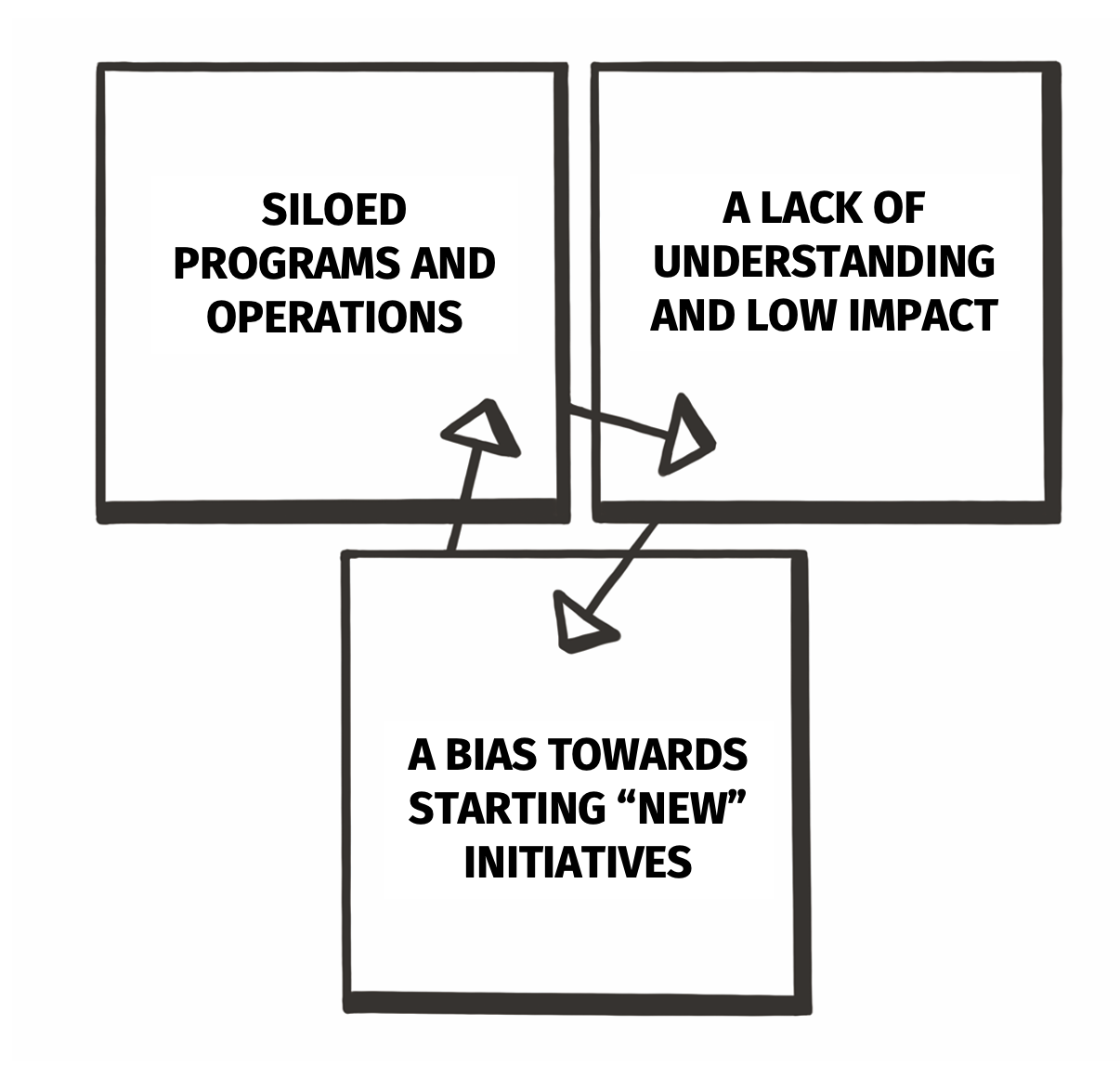
If you zoom out, we not only do this in local communities, but we also seem to do it as a sector overall. Over the last decade, how many new “shiny objects” have come along promising to revolutionize our movement?
- Mid-2010s … By-Name-Lists
- Late 2010s … Housing First
- Early 2020s … New Types of Shelter
- Early 2020s … Equity and Lived Experience
- Mid-2020s … Narrative Change
- Mid-2020s … Encampments
- Now … Prevention
- Next ... AI???
Again, there is no one bad actor here, and genuine insights have emerged during each of these periods.
However, the sum result is that we spend enormous time and energy building and learning about a new part of our system only to move onto something else, ultimately failing to absorb and standardize what was learned.
It's the Same Everywhere
Last time I talked about the importance of trying to build a shared conceptual foundation and vocabulary for standardizing the core building blocks of homeless systems of care.
While STEPS is far from perfect, it’s a simple framework that has now successfully been used in almost every part of California - the Bay Area, San Diego, and LA - to help drive strategy, innovation, change management, and financial accountability.
The core idea, which you can read more about here, is that at the end of the day, there are only a handful of basic programmatic building blocks common to all systems of care. In turn, these building blocks cover a consistent handful of strategic priorities, which I would argue also apply to every single system of care in the country.
- TRIAGE ... Slowing inflow
- ENGAGEMENT ... Ensuring experiences of homelessness are brief
- ENGAGEMENT ... Reducing unsheltered homelessness
- PLACEMENT ... Accelerating outflow
- SYSTEMS ... Strengthening overall system coordination
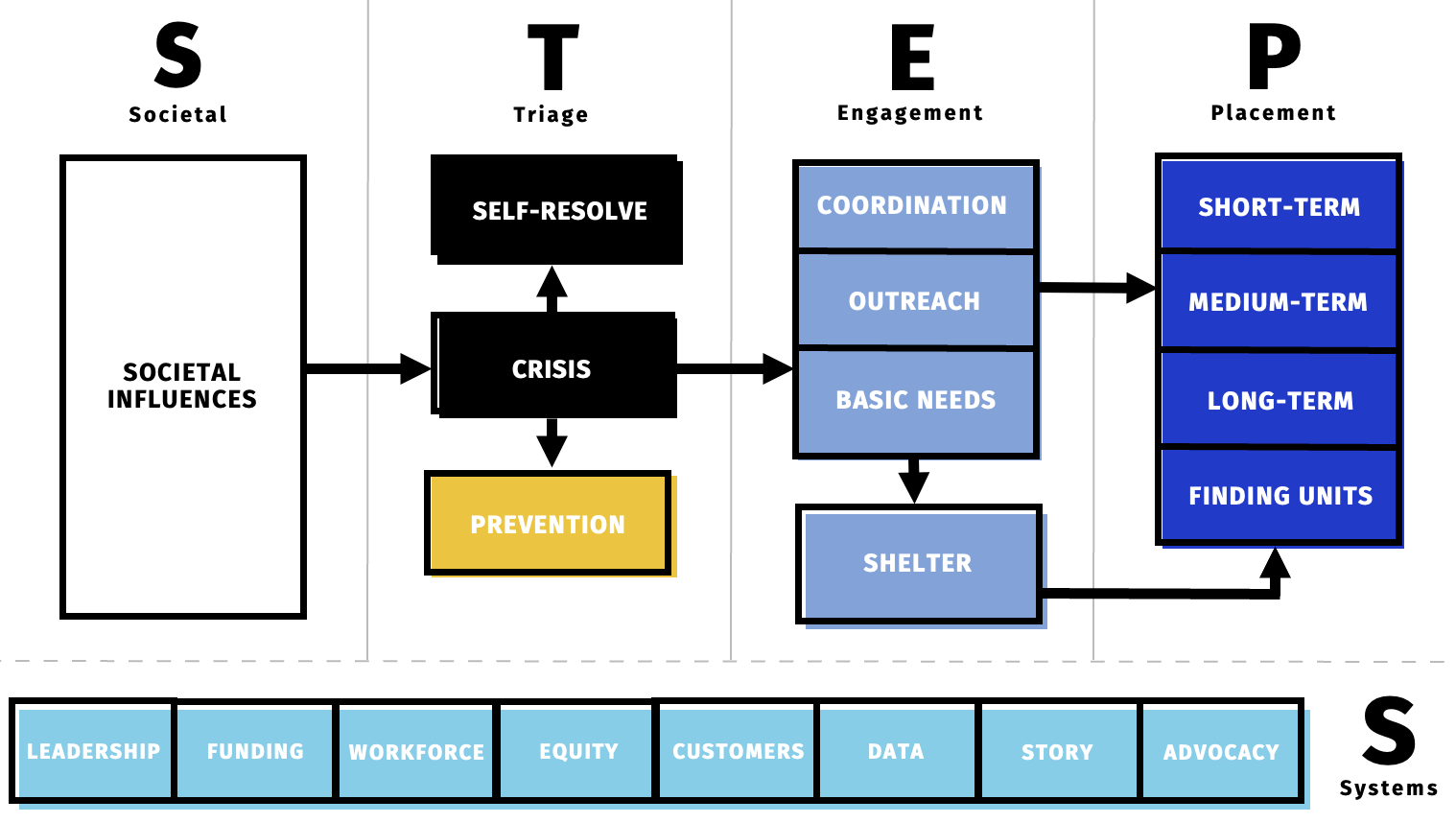
As I asked last time, if the Continuum of Care (CoC) is the basic boundary for “local efforts,” then …
Are we 400 separate communities each responsible for figuring out our own strategies and doing our own thing?
OR
Are we a strong and unified movement implementing a shared strategy in 400 nuanced ways?
If it’s the latter, then one of the fastest ways to accelerate sector-wide performance would simply be taking a specific building block, let’s say shelter, and then lining up the 400 different approaches to shelter all across the country.
Having had the chance to work in and learn about a lot of different communities, I’ll tell you exactly what emerges - some communities are doing a great job and see high numbers of people exiting shelter to permanent housing, and other communities are really struggling.
This isn’t to shame. It’s more to suggest that however your community is operating a particular system component, it is critical to recognize that your program design and associated performance sits on a spectrum that covers all 400 CoCs. Therefore, the fastest and most effective way to "innovate" and improve local performance is to simply copy what is working higher up on the spectrum.
(The objection I always get to this is - what about rural vs. urban or West Coast vs. Midwest? I genuinely believe we can learn from every community in the country, but it’s just as easy to think of a smaller subset of communities with its own spectrum, such as West Coast rural communities. The key point is the mindset shift of seeing the spectrum).
A Concrete Example You Can Use Today
I am completely convinced that all of the best practices that we need to solve homelessness already exist - they’re just unequally distributed. Thus, what we need as a movement is not more “innovation” (i.e., trying new things just to do something new). What we need is innovation around how we innovate.
I know from firsthand experience working with teams in some of the biggest CoCs in the country that this way of thinking can rapidly drive dramatic results:
- A 28% drop in chronic homelessness
- A 33% drop in overall homelessness
- A 37% drop in unsheltered homelessness
Here is the exact approach, which you can replicate for any part of your system.
Using STEPS and looking across our sector, simply ask - what are the very best ways to operate a specific programmatic component and/or group of interconnected components?
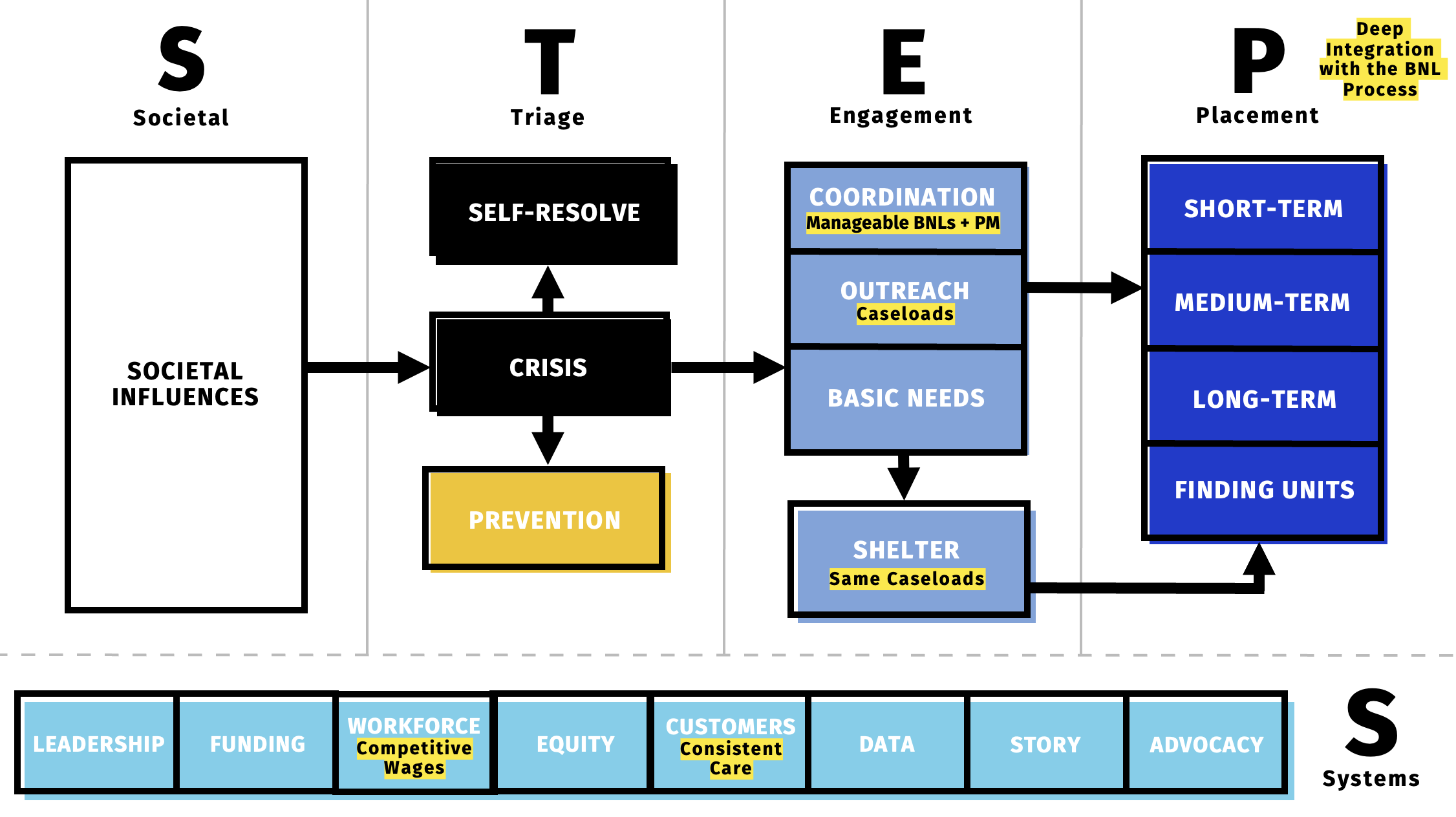
Using "coordination" and "outreach" as an example, I think our sector has surfaced the following key insights, dare I say standards:
- Manageably-sized By-Name-Lists (max 250 names)
- Dedicated project management to facilitate By-Name case conferencing
- If needed, additional administrative capacity to manage multiple By-Name-Lists
- Robust data-sharing and regular system level reporting on inflow and outflow
- Caseload-based outreach to ensure consistent care relationships
- Caseloads derived and tracked from the By-Name-List
- A process that very tightly links outreach efforts with Coordinated Entry
- (Sources of inspiration: Community Solutions, Clutch Consulting, Dallas, etc.)
Presented like this, it’s a little difficult to know where to begin. So instead, imagine this as a spectrum that your community can move up and down.
The Best Practices Identified Above Matched to STEPS
The Best Practices Above Placed on a Spectrum
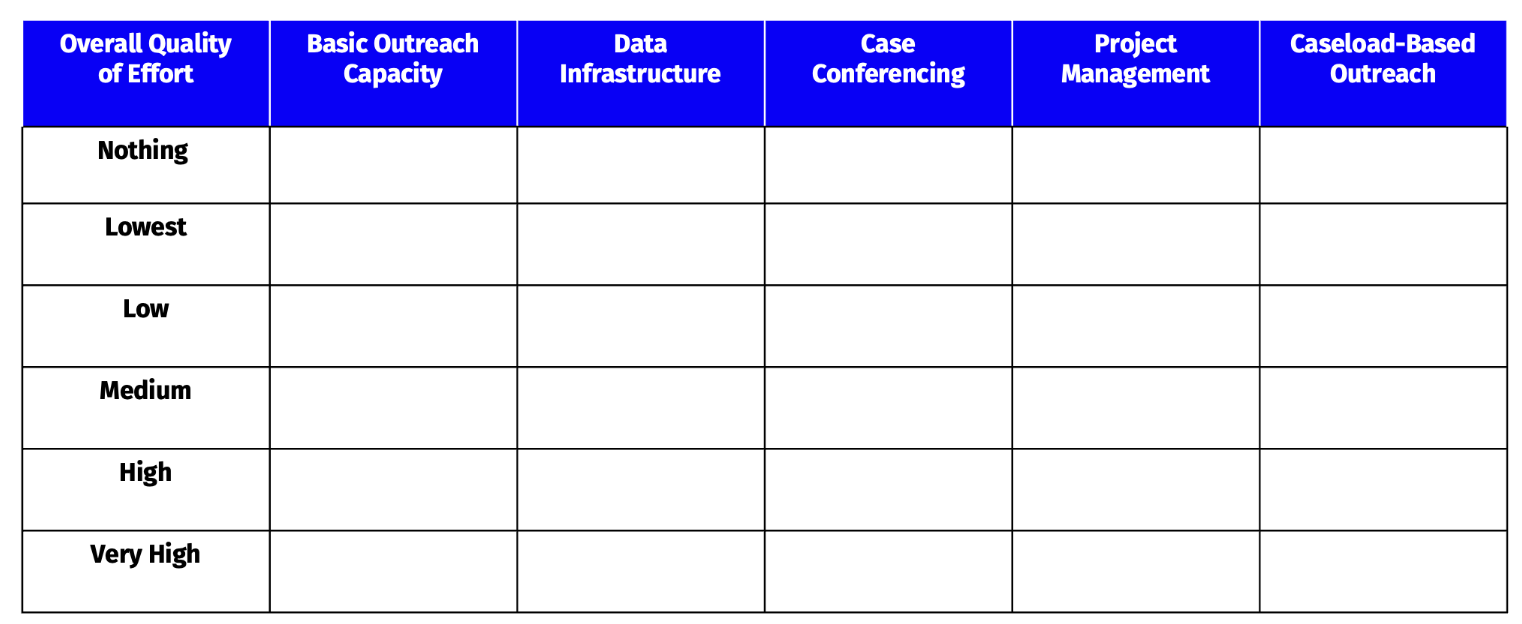
The Typical Progression of How Communities Move Up This Spectrum
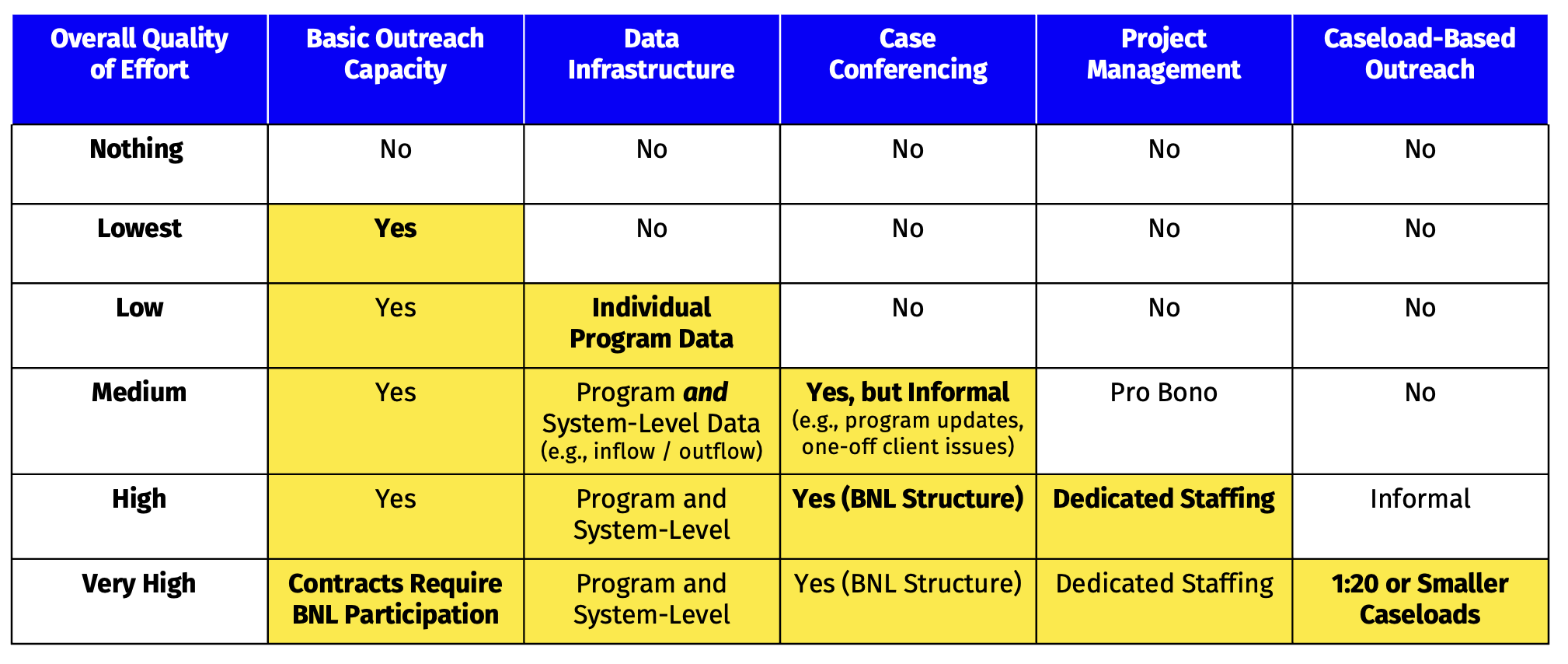
Again, this is not perfect and should be continually refined, but seeing our systems this way, even just a part of them, can provide tremendous value and clarity.
Within the last month, for example, I used this framework with the funders and providers in a community to simply assess where everyone thought they were on the spectrum.
I very sincerely appreciated everyone’s honesty, candor, and courage because despite a lot of investment and effort, their community was stuck at “medium.”
While this was admittedly demoralizing, they were also encouraged.
For one, this simple visual helped build consensus in less than two hours. They didn’t need an expensive and lengthy strategic planning effort. They just needed lunch, this graphic, and a couple of hours for honest conversation.
Second, and more importantly, this framework and way of thinking provided a clear roadmap for what to do next. To accelerate momentum, they need to:
- Formalize case conferencing around a By-Name-List (this has been done all over the country and is relatively easy to replicate)
- Identify a dedicated project manager, and amazingly, a local funder volunteered staff to facilitate the meetings, drive actions, and track data
From experience, I know it will take another 6-12 months to truly progress from “medium” to “high,” but having seen this enough times, I also know that communities that make this transition consistently see at least a 30% drop in homelessness.
Your Expertise
If this is the performance spectrum for day-to-day coordination and outreach, which are tied to the system priority of reducing unsheltered homelessness, I’d love your thoughts on what the spectrums might look like for other parts of the system:
- Slowing inflow
- Accelerating outflow
- Shelter throughput
- Overall system alignment
To do this, simply think of 4 or 5 components of really strong responses in these areas.
Then, think about how these components tend to sequence or build on each other.
I really think it’s important that we open source all of this to our movement, and I will share the results in a future newsletter.
If you like this - if this gives you energy, excitement, and a sense of hope that we can in fact make progress despite the very real challenges we’re currently facing - I would ask that you please share this in your community.
Next time I’m going to tell you how you can use the STEPS framework to ensure financial accountability in your community.