
Strategic Plans Are NOT Strategy
A few years ago I had the incredible opportunity to serve as the Chief Strategy Officer for San Diego’s Continuum of Care.
While I was incredibly excited about the opportunity, if I’m being completely honest, I was also terrified.
For starters, San Diego’s CoC is led by a nonprofit called the Regional Task Force on Homelessness (RTFH). And my former colleagues have incredible resumes - co-leading the major reduction in homelessness in Utah, as well as helping to create the State of California’s first interagency division to oversee homelessness.
Compared to them, what did I know?
I had spent the last 13 years in the Bay Area and had only just moved to San Diego a few months prior.
Even though I had started my career in San Jose, CA, the 10th largest city in the country, most of my experience was in relatively smaller counties in the Bay Area (PITs of 1,000 to 3,000).
While I had had the great fortune of being a part of teams in those communities that had in fact driven significant reductions in chronic, unsheltered, and overall homelessness, how was that going to compare to a community with:
- 18 local cities
- 6 Public Housing Authorities
- 100+ providers in HMIS
- 1,400+ individual users in HMIS
In 2024, there were 10,605 people counted during San Diego’s PIT, making it the 7th largest CoC in the country.
Strategic Plans Are NOT Strategies
In the end, my job wasn't about creating a new strategic plan. Instead, it was focused on evaluating the progress of the Regional Plan that had been adopted two years earlier.
We often referred to it as our “Plan of Plans,” since in many ways it was attempting to cobble together a multitude of existing planning efforts:
- 5 national plans
- 2 statewide plans
- 6 sub-regional plans
- 7 city-specific plans
At 71 pages, it included:
- 10 critical system challenges
- 10 guiding principles
- 10 system goals and priorities
- 20 strategies
- 113 actions
- Subregional nuance
- All the terms and buzzwords you would expect
The Regional Plan truly was outstanding and represented everything you would ever want in one of these documents.
There was just one problem. I had spent the previous few years billing myself as the strategic planning consultant that didn’t believe in strategic plans.
When I shifted from working in government to working with governments as a consultant, what I immediately recognized was that the problem in many communities wasn’t a lack of “strategic planning” documents. What was missing was an actual strategy.
I wasn’t just saying this to be cute or witty. It was based on the experience I had actually had.
Prior to making the jump to consulting, I had been part of an incredible team that drove a two-year, 28% countywide reduction in chronic homelessness, as well as a 30% drop in unsheltered homelessness in the city where I worked.
We never had a formal written plan guiding this progress. Instead, at the risk of dramatic oversimplification, we just had a great strategy:
- Focus on a core part of our system (chronic homelessness)
- Copy what’s working in other communities that are making more progress than us
- Once we’d met the performance benchmarks set by our peers, only then could we innovate and try to push past their original progress
It's the Same Everywhere
The challenge with replicating this strategy was twofold.
First, I kept running into a culture or mindset of “homelessness is different here.”
Rather than seeing the ways in which we’re similar, I often see a tendency in our sector to emphasize differences - our political leaders are different, our housing markets are different, our providers are different, etc.
This perspective keeps many communities from being willing to look for successful efforts in other communities and then borrowing and implementing what has already proved to work.
I know this is a major issue because this was the exact inertia that we had to overcome to get the results that we did.
The second issue was that even when there was an openness to learning and borrowing, there is a very real logistical challenge in the way in which our sector constantly rebrands and uses inconsistent terminology for what are essentially the same building blocks common to all systems of care.
Consider something as simple as “shelter.” In California, I have heard it referred to as everything from:
- Shelter
- Emergency shelter
- Congregate shelter
- Non-congregate shelter
- Sleeping cabins
- Safe parking
- Safe sleeping
- Safe havens
- Transitional housing
- Temporary housing
- Crisis housing
- Bridge housing
- Interim housing
- Interim bridge housing 😂
If I'm confused by all of this, why would we expect executive policymakers and elected leaders to grasp what we're asking them to support?
Yes, there are of course physical and programmatic nuances to all of these efforts, but the deeper point is that our lack of shared language makes it very difficult to compare all of these forms of shelter against one another and figure out which models actually work and which don't.
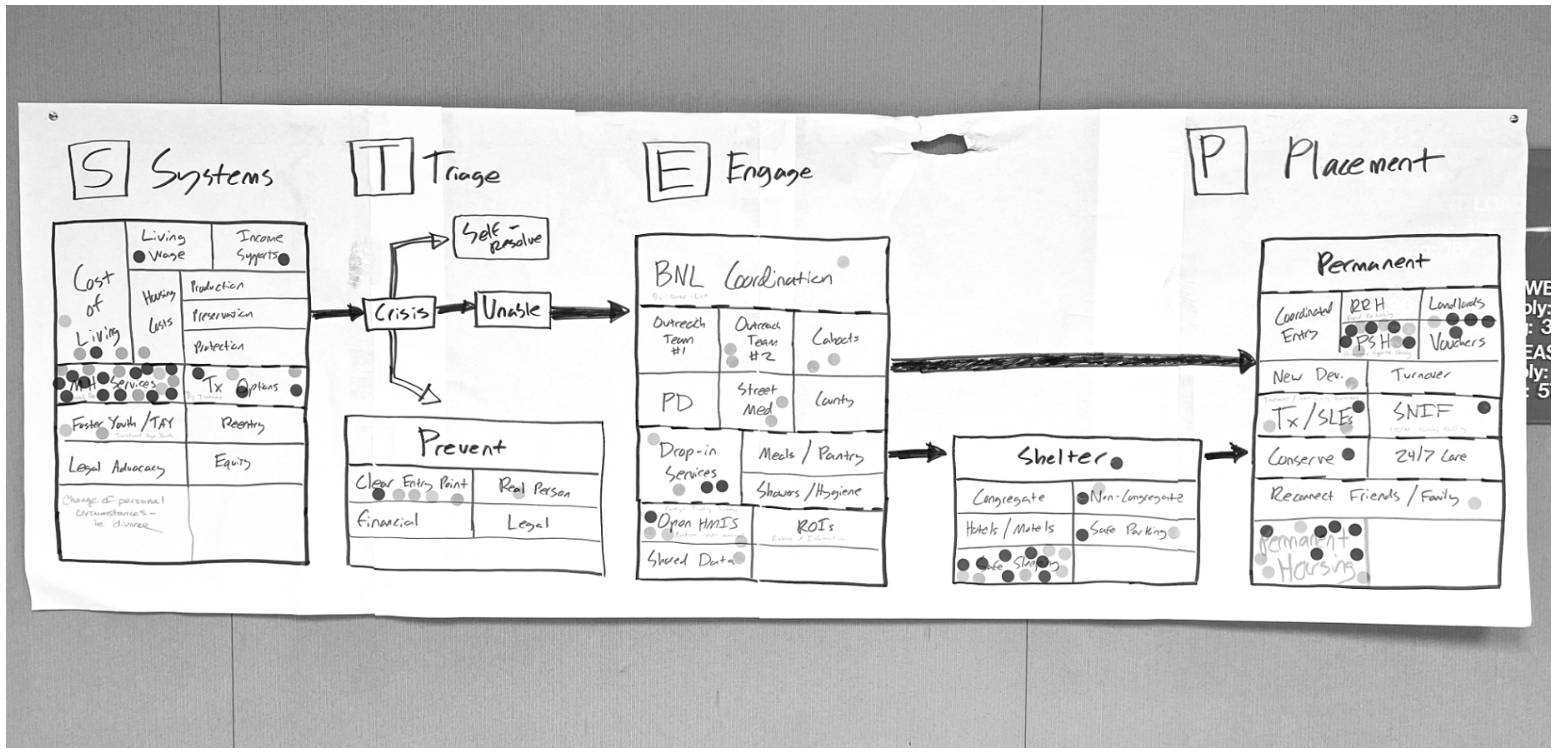
Thus, in an effort to overcome this lack of "standardization," I spent years sketching out the earliest iterations of STEPS on the wall in my garage and then testing it with practitioners, community leaders, and people with lived experience.
Version 8.0 - Garage Iteration
Version 20.0??? - Current Iteration
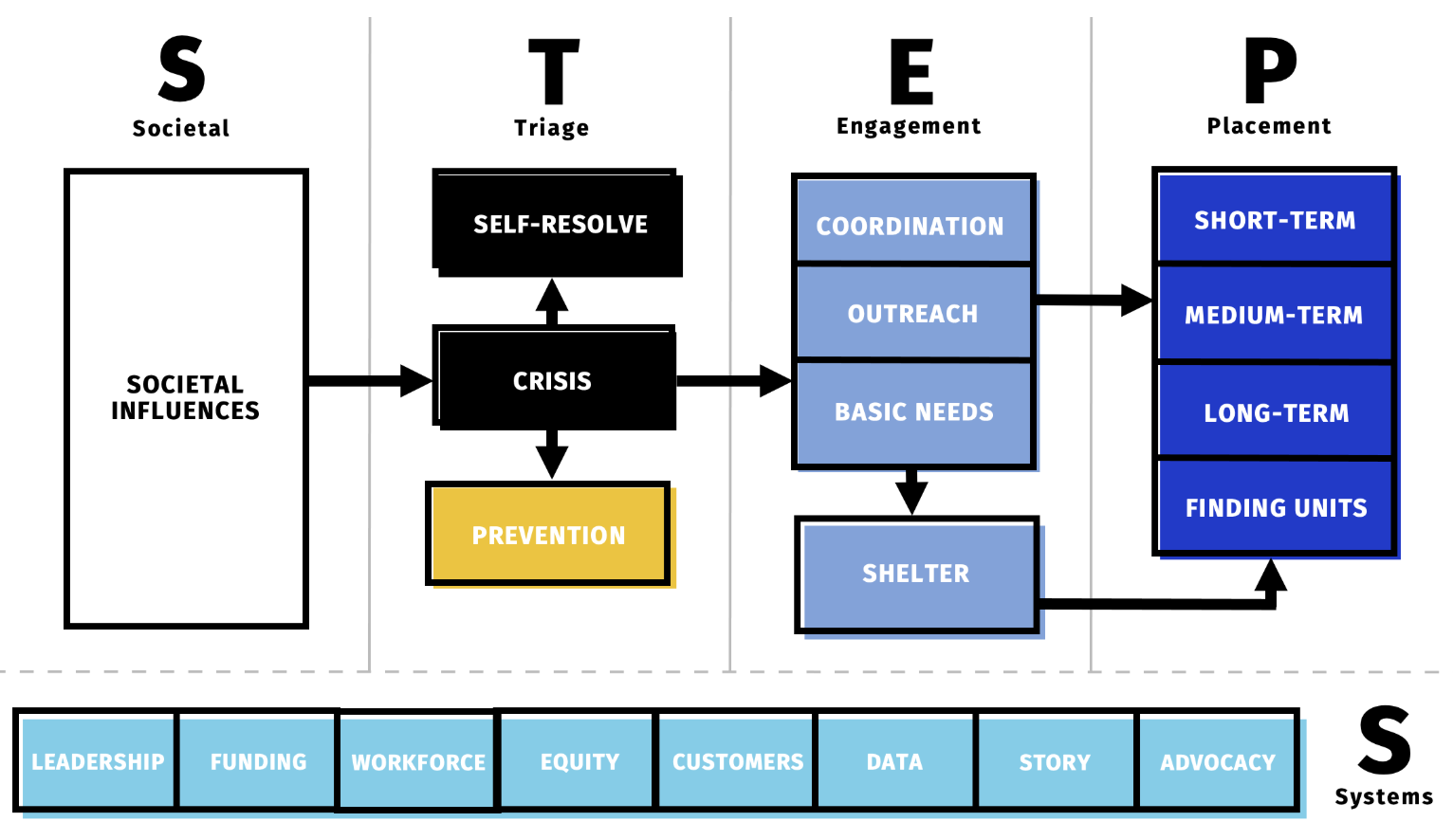
STEPS is intended to be a jargon free, customer journey map visualizing how people typically flow through the basic building blocks of our systems of care.
Is it perfect? No.
Is there nuance from community to community in how these building blocks manifest? Absolutely.
The important point is that our foundational language can and should be the same.
The Turning Point
After about six months and untold spreadsheets attempting to analyze our progress, the key insight for our team in San Diego finally emerged.
The Regional Plan and STEPS weren’t mutually exclusive. In fact, the core strategic priorities in the plan mapped perfectly to the overarching service categories in STEPS.
In other words, if the fundamental parts of a system of care don’t really change, then the associated strategic priorities for those parts also don’t change.
If you stop and think about it, doesn’t this seem true for our entire sector? Are there really any more fundamental priorities than:
- Slowing inflow
- Accelerating outflow
- Decreasing the time from when homelessness starts to when it ends
- Reducing unsheltered homelessness
- Strengthening overall system coordination
From this breakthrough, we realized that we didn't really need a big "Plan of Plans." Instead, what we needed was a series of workstreams around each of these unwavering parts / priorities in the system. Within these workstreams, we could then establish annual and quarterly project management cycles to help us group similar initiatives, prioritize among competing opportunities, and rigorously evaluate from shared metrics.
In time, this process could replace the need for long-term strategic planning efforts because the process was the strategy.
The Mindset Shift
After 16 years of working in our movement, I would push in all my chips and say that our number one strategic barrier is not President Trump, it’s not the media, and it’s not NIMBYs.
Our number one barrier is ourselves.
For the last 45 years, since the dawn of The Modern Homelessness Crisis, we have hopelessly decentralized and fragmented our response.
It is this structure that explains what often happens within communities:
- Overlapping engagement efforts, leading to multiple teams contacting the same individual without a coordinated strategy
- Inconsistent triage and referral practices, limiting the ability to prioritize and move complex cases toward housing
- People experiencing homelessness do not see the system as a viable solution to their challenges, and they understandably disengage, becoming harder to help later
- The public becomes increasingly frustrated by the lack of progress, putting more pressure on all involved and exacerbating everything above
This structure also explains what happens across communities (i.e., across our sector and movement):
- Wildly different system designs, even across neighboring cities and counties
- Endlessly rebranding what are essentially a handful of basic building blocks common to all systems of care, preventing meaningful comparison and learning
- A tendency to borrow best practices without fidelity, producing worse outcomes than the original interventions and often discrediting the original innovations as a result (e.g., Housing First)
- An inability to articulate the true cost of our efforts, thus preventing access to the resources we actually need to drive sustained reductions
The goal of this newsletter has always been to spark and accelerate momentum around solutions, and this post is meant to lay the conceptual groundwork for how we might approach that.
If the CoC is the basic boundary for “local efforts”, then …
Are we 400 separate communities each responsible for figuring out our own strategies and doing our own thing?
or
Are we a strong and unified movement implementing a shared strategy in 400 nuanced ways?
This is a subtle, but extremely important distinction, and in the coming weeks and months, I'll provide explicit case studies for how you can leverage this mindset shift to rapidly drive change in your community.
Please Help Spread the Word
My crazy audacious goal is to eventually have 10,000+ civic leaders working to end homelessness subscribed to this newsletter. If you find this content useful and helpful, I would genuinely appreciate your help spreading the word.
Thank you so much for your partnership!
- Andrew